NCE3400 vs NCE2305 vs NCE2302 — NCE SOT-23 MOSFET Selection Guide | ICMASS
NCE3400 vs NCE2305 vs NCE2302 — NCE SOT-23 MOSFET Selection Guide | ICMASS
Three SOT-23 MOSFETs from NCE Power. Three different jobs. The NCE3400 is the N-channel workhorse (30V/5.8A, 24mΩ). The NCE2305 is the P-channel high-side switch (-20V/-4.1A, 52mΩ). The NCE2302 is the N-channel speed specialist (20V/2.9A, 33mΩ, 4.0nC gate charge). Pick the wrong one and you're either overpaying for specs you don't need, or fighting a topology problem that the right MOSFET would have solved. Here's how to get it right the first time.
NCE3400 vs NCE2305 vs NCE2302: Full Parameter Comparison
| Parameter | NCE3400 | NCE2305 | NCE2302 |
|---|---|---|---|
| Channel Type | N-Channel | P-Channel | N-Channel |
| VDSS | 30V | -20V | 20V |
| ID (continuous) | 5.8A | -4.1A | 2.9A |
| Package | SOT-23 | SOT-23 | SOT-23 |
| RDS(on) @ 4.5V | 24mΩ typ | 52mΩ typ | 33mΩ typ |
| RDS(on) @ 2.5V | 28mΩ typ | 75mΩ typ | 40mΩ typ |
| VGS(th) | 0.9V typ | -0.7V typ | 0.75V typ |
| VGS Max | ±12V | ±12V | ±12V |
| Gate Charge (QG) | 10nC | 7.8nC | 4.0nC |
| Input Capacitance (CISS) | 825pF | 740pF | 300pF |
| Power Dissipation (PD) | 1.4W | 1.7W | 1.0W |
| Avalanche Rated | No | No | No |
| Gate Drive Polarity | High = ON | Low = ON | High = ON |
| Typical Topology | Low-side, DC-DC | High-side switch | Low-side, PWM |
| Relative Cost | $$ (mid) | $$ (mid) | $ (lowest) |
Which MOSFET for Which Job?
Key Differences Explained
1. N-Channel vs P-Channel: The Topology Decision
This is the first question you should ask. Not "which has better specs" — all N-channel MOSFETs have better specs than P-channel MOSFETs of the same die size. The question is: what does your circuit topology demand?
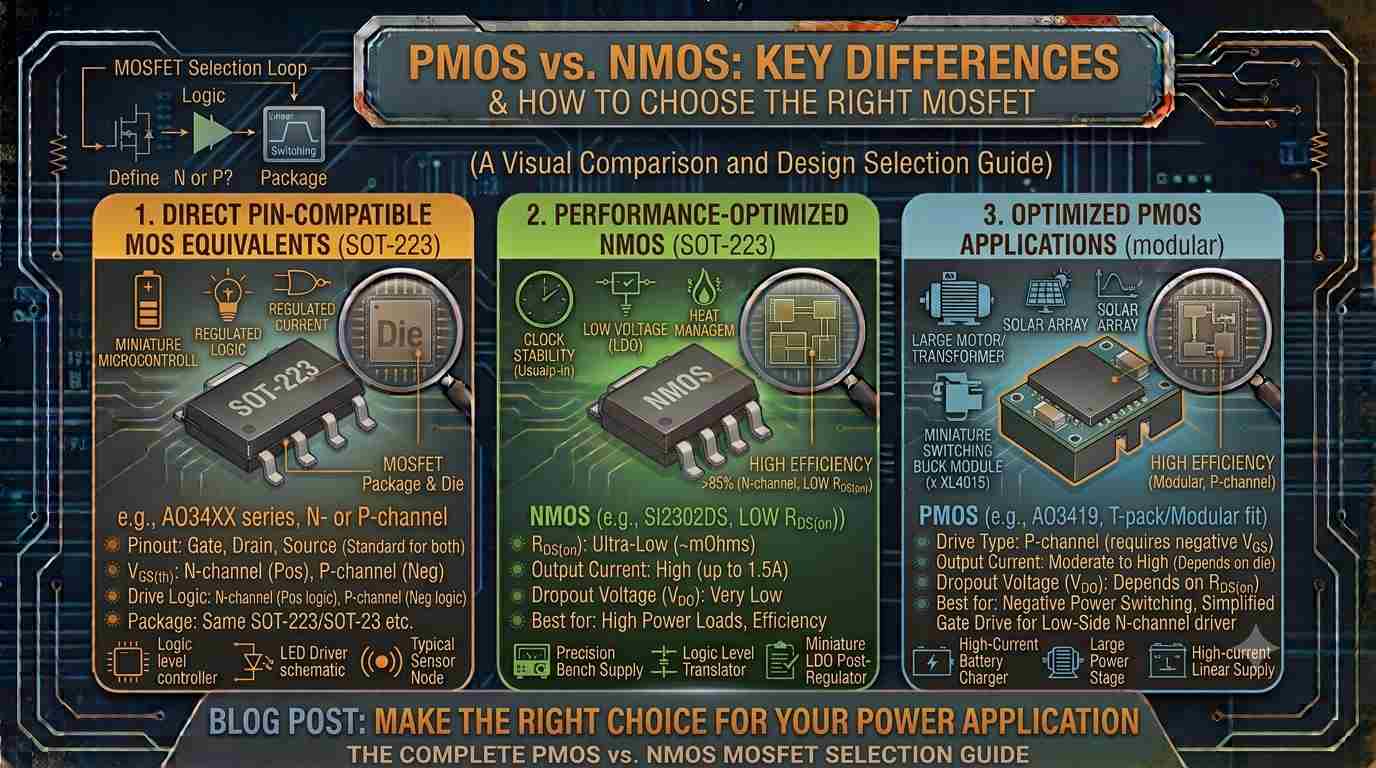
N-channel (NCE3400, NCE2302): Switch on the low side — between the load and ground. Turn on by driving the gate high. Best RDS(on) for the money. Use for DC-DC converters, motor drivers, LED drivers, battery protection (low-side). P-channel (NCE2305): Switch on the high side — between the supply rail and the load. Turn on by driving the gate low. Higher RDS(on) for the same die area, but you don't need a charge pump or bootstrap circuit. Use for load switches, reverse polarity protection, peripheral power gating.
2. Voltage Headroom: 20V vs 30V
The NCE3400's 30V VDS rating gives you design margin that the 20V parts don't have. In a 5V circuit, 20V seems like plenty of headroom — and it usually is, until a load dump, hot-plug transient, or inductor flyback pushes the drain above 20V for a microsecond. The NCE3400 gives you 10V of margin above the 20V parts. The NCE2302 and NCE2305 are perfectly safe in 5V systems with good layout; the NCE3400 is safer in anything that might see a transient.
3. Switching Speed: NCE2302 Is in a Different League
The NCE2302's 4.0nC gate charge is less than half the NCE3400's 10nC. In a PWM application, that translates directly to lower gate drive current, faster edges, and less switching loss. See the QG bars above: the NCE2302 needs 40% of the drive energy that the NCE3400 requires for each switching cycle. At 500kHz, that's the difference between a cool-running MOSFET and one that needs a heatsink. The trade-off: the NCE2302 gives up voltage rating (20V vs 30V) and current capacity (2.9A vs 5.8A) to achieve those numbers.
When to Choose Which
Choose NCE3400 When:
- You're switching the low side and need the lowest RDS(on) (24mΩ)
- Your load current is above 3A (up to 5.8A)
- Your circuit might see voltage transients above 20V
- You need one MOSFET that covers most designs — the NCE3400 is the safest default
- Applications: DC-DC converters, motor drivers, battery protection (1S–2S), general low-side switching
Choose NCE2305 When:
- You need to switch the high side (positive rail) without a gate driver IC
- Your supply is 5V or below — within the ±12V VGS safe range
- You want reverse polarity protection with near-zero voltage drop
- Load current is under 3A (4.1A abs max)
- Applications: USB power switches, peripheral power gating, reverse-battery protection, high-side load switches
Choose NCE2302 When:
- You need high-frequency PWM (200kHz+) with minimal gate drive current
- Your design is 5V or below and current is under 2A continuous
- You want the lowest-cost NCE SOT-23 MOSFET that still delivers logic-level drive
- Gate charge matters more to you than raw current capacity
- Applications: LED PWM dimming, small motor speed control, high-frequency DC-DC, cost-sensitive battery protection
Why Buy NCE SOT-23 MOSFETs from ICMASS?
All three in stock, one shipment. Most designs use at least two types of MOSFETs — N-channel for the heavy lifting, P-channel for the high-side switches. We stock the full NCE SOT-23 family plus alternatives from AO, Vishay, and ON Semiconductor. One order covers your entire MOSFET BOM.
Batch-tested for gate leakage and VGS(th) shift. NCE MOSFETs are widely sourced across Shenzhen distribution. We verify incoming lots against factory specs before they enter inventory.
Cross-reference support. Not sure which of these three fits your design? Tell us your topology, supply voltage, load current, and switching frequency. We'll tell you which MOSFET to use — and stock the alternatives if you need them.
Shenzhen stock, same-day dispatch before 15:00 CST. Contact ICMASS for current pricing on your quantity. Volume pricing typically ranges from $0.015–$0.06/unit depending on model and order size.
Frequently Asked Questions
Q1: Can I use the NCE2305 for low-side switching too?
A: You can, but you shouldn't. A P-channel MOSFET on the low side works, but the gate drive logic is inverted (low = ON, high = OFF) and you get worse RDS(on) for the same money. If you're switching the low side, use an N-channel part. The NCE2305's entire reason to exist is high-side switching. Using it anywhere else is paying the P-channel penalty for no benefit.
Q2: Can I just use NCE3400 for everything?
A: For low-side switching, yes — it's the safest default. The NCE3400 covers 80% of SOT-23 MOSFET applications. The 30V/5.8A rating with 24mΩ RDS(on) is the best all-around spec in the NCE SOT-23 family. The two reasons not to: (1) if you need high-side switching, you want the NCE2305; (2) if you're doing 200kHz+ PWM at low current, the NCE2302 switches faster and costs less.
Q3: Why is the NCE2305 RDS(on) so much higher?
A: It's P-channel. This is physics, not a design flaw. In silicon, electrons (N-channel carriers) move roughly 2.5× faster than holes (P-channel carriers). To match an N-channel MOSFET's RDS(on), a P-channel part needs about 2.5× the die area — which won't fit in SOT-23. Every P-channel MOSFET in this package class has RDS(on) in the 40–80mΩ range. You're trading on-resistance for topology simplicity.
Q4: Are any of these MOSFETs pin-compatible with each other?
A: Yes — all three use the same SOT-23 pinout (Pin 1=Gate, Pin 2=Source, Pin 3=Drain). You can swap between them without PCB changes. But verify the gate drive polarity: N-channel and P-channel require opposite gate signals. Swapping an N-channel for a P-channel without changing the gate drive logic will leave the FET permanently on or permanently off.
Q5: Which one for a 3.3V MCU driving a 5V peripheral?
A: NCE2305 if the peripheral is on the high side; NCE2302 if it's on the low side. Both have VGS(th) under 1V, so a 3.3V GPIO drives either one fully on. For high-side switching, the NCE2305 with Gate=0V gives VGS=-5V. For low-side switching, the NCE2302 with Gate=3.3V gives VGS=3.3V — past the 2.5V point where RDS(on) flattens out. The NCE3400 also works on the low side but is overkill for a 5V/100mA peripheral.
Q6: Can I parallel different models, like NCE3400 + NCE2302?
A: Technically yes for N-channel + N-channel, but not recommended. When you parallel MOSFETs with different RDS(on) and gate charge, the one with lower RDS(on) carries more current and switches slower — creating imbalance. For best results, parallel two of the same model. Never parallel an N-channel with a P-channel — they'll fight each other.
Related Products
Related information
-
LNK304DN-TL Power Integrations
-
LNK304GN-TL Power Integrations
-
LNK304DG-TL Power Integrations
-
TNY277PN Power Integrations
-
TNY276PN Power Integrations
-
TNY278PN Power Integrations
-
TNY278GN-TL Power Integrations
-
TNY280GN-TL Power Integrations
-
TOP266KG-TL Power Integrations
-
TOP258PN Power Integrations
-
TOP253PN Power Integrations
-
TOP253PNAU Power Integrations

- 1500+ Daily average RFQ Volume

- 20,000.000 Standard Product Unit

- 1800+ Worldwide Manufacturers

- 15,000+ In-stock Warehouse